

Why online retail is currently undergoing fundamental changes
AI in eCommerce is often reduced to chatbots, product recommendations, or automated texts. That falls short. The real transformation begins where AI no longer just advises but acts.
Until now, online shopping worked like this: People search, compare, click, decide.
In the future, AI agents will take over exactly these steps – faster, more consistently, and without fatigue.
For shop operators (regardless of whether WooCommerce, Shopware, or Shopify), this is not a convenience feature but a structural change:
- The purchasing decision is shifting away from humans.
- The competition is shifting from design and storytelling to data, availability, and process quality.
- Platforms and AI operators gain additional influence.
In short: Agentic Commerce is not a feature. It is a new logic of buying.
Today’s fundamental problem: fragmented commerce journeys
A typical online purchase today involves many interruptions:
- Search (Google, marketplaces, comparison portals)
- Click into a shop (WooCommerce, Shopware, Shopify, …)
- Filter and Compare
- Shopping cart
- Checkout (Address, Shipping, Payment)
- Status, Return, Invoice, Support
Technically, these are different systems: shop frontend, product data, payment provider, shipping service provider, CRM, support.
For humans, this is tedious but doable. For AI agents, this very fragmentation is the biggest obstacle.
Agentic Commerce addresses this: AI agents are intended to bridge these gaps, orchestrate processes, and treat the entire purchasing process as a continuous operation. This requires shared interfaces and rules – later, the Universal Commerce Protocol (UCP) comes into play here.
What “Agentic Commerce” specifically means
Definition: Agentic Commerce simply explained
Agentic Commerce refers to a form of digital commerce in which AI agents prepare purchasing decisions and partially execute them themselves.
Man defines:
- Goals (e.g., affordable, fast, sustainable)
- Rules (e.g., preferred dealers, brands)
- Limits (e.g., budget, approvals)
The agent takes over:
- Recognize needs
- Find and compare offers
- select optimal options
- Place order
- Accompany after-sales processes
You can imagine it like a personal shopper who works around the clock – only software-based.
Distinction from traditional e-commerce
| Classic e-commerce | Agentic Commerce |
|---|---|
| Human searches and clicks | Agent searches and acts |
| Shop optimizes conversion for people | Optimize system agent compatibility |
| Personalization = Recommendations | Personalization = autonomous procurement |
| Frontend is central | APIs & Data Quality Become Central |
For shop owners, this means:
- No longer just: “How does my shop convince the visitor?”
- But rather: “How efficient, reliable, and compliant can an agent purchase from me?”
This applies to WooCommerce shops just as much as Shopware or Shopify installations. No system is automatically “agentic-ready.” What matters is the architecture, not the label.
Typical use cases in everyday life
Agentic Commerce is particularly strong where users no longer want to search but expect a result:
- Replenishment: Consumables, spare parts, office supplies
- Price and delivery optimization: Agent buys at the optimal time
- B2B purchasing: budgets, roles, approvals, invoices
- After-Sales & Support: Tracking, Return, Warranty, Invoice
- Cross-Channel: Online shop + branch (Click & Collect, POS stocks)
These use cases are the reason why agentic commerce is not theoretical, but economically relevant.
The 5 central end-user use cases (practical)
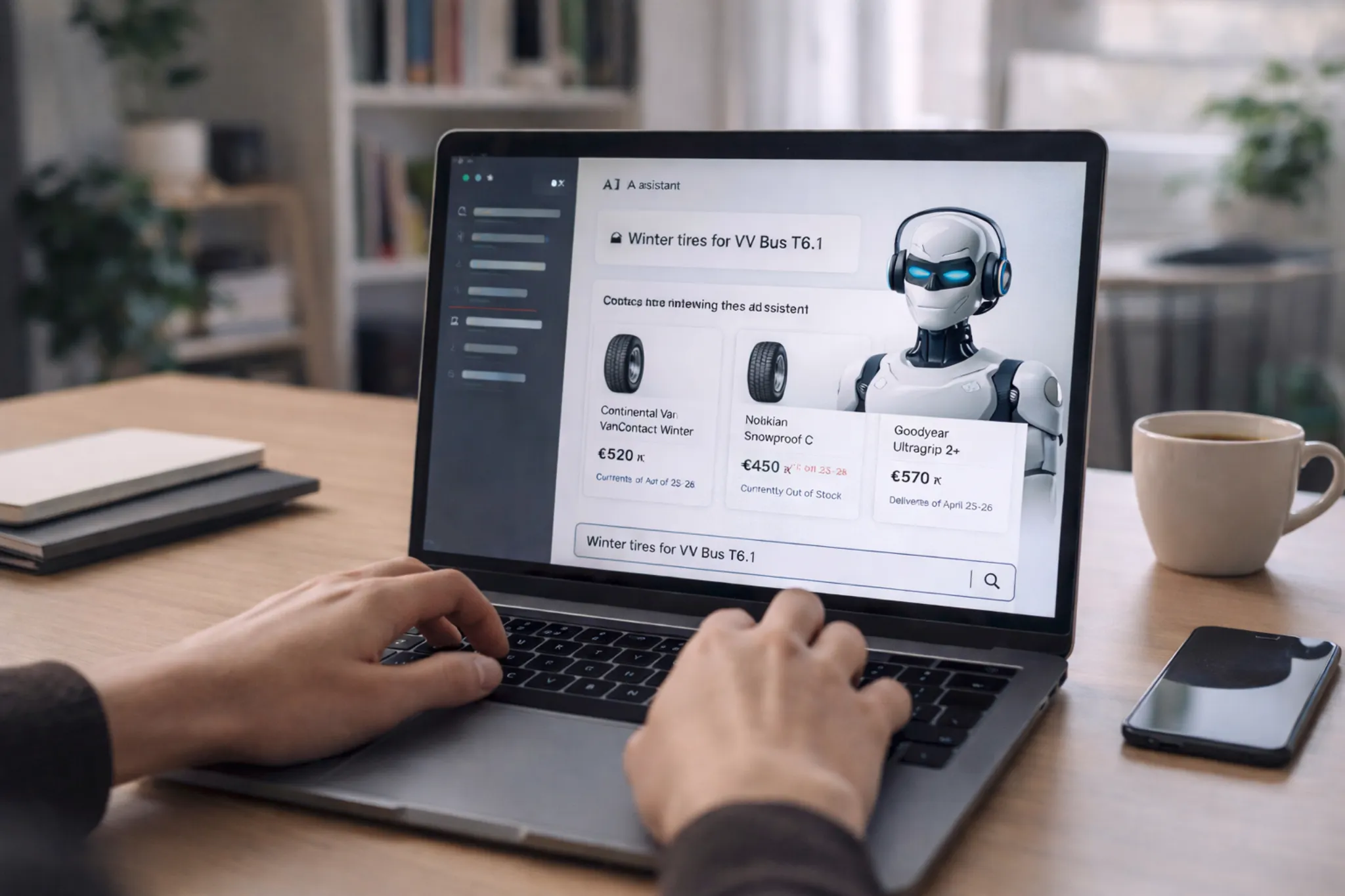
Use Case A: “Search → Purchase” in AI chat (winter tires example)
A user writes in an AI chat:
“Winter tires for VW Bus T6.1”
An agentic process ideally looks like this:
- Recognize intent & framework conditions (vehicle model, product type, possibly budget)
- Ask targeted follow-up questions – only when necessary (e.g., tire dimension from the vehicle registration)
- Find offers in a structured way (products with price, availability, delivery time – not just SEO hits)
- Compare & recommend (best price-performance, fastest delivery, premium)
- Prepare cart & checkout (address, shipping, payment)
- Place order (incl. payment authorization)
- Accompany post-purchase (tracking, invoice, return, complaint)
The difference from today’s product search: The AI does not stop at the list, but at the purchase completion.
Use Case B: Conversational Re-Order (Repeat Purchase)
Examples:
- Order me the same printer cartridges as last time.
- Buy my protein bar again, this time three boxes.
This is where agentic commerce is extremely efficient:
- No search
- No comparison
- No decision
The agent checks availability, suggests alternatives, and places the order. For shops, this is a clearly measurable conversion lever.
Use Case C: Bundle & Compatibility Purchases
Example: “I need everything for the installation of a wallbox in the garage.”
The agent coordinates:
- Main product
- Accessories
- if applicable service
- Compatibility
This is difficult with classical filters, but much easier to solve with agentic logic.
Use Case D: Product + Service + Appointment
Example: “Buy winter tires and book installation nearby.”
The agent:
- select the product
- finds an assembly partner
- coordinates appointments
- clarifies billing
This goes beyond pure webshops – but it is a realistic mass market.
Use Case E: Post-Purchase-Support
Typical inquiries:
- “Where is my package?”
- “I want to send this back.”
- “I need the invoice.”
- “Warranty case.”
Agentic Commerce covers the entire end-to-end commerce journey – not just the purchase.
Agentic Commerce as a Power Shift in Online Retail
Agentic Commerce changes who decides, who is visible, and who controls the margin. As soon as the purchase no longer primarily occurs through a human website visitor, but through an AI agent, the central customer interface shifts. Not gradually. But structurally.
The AI agent as a new layer of intermediation
If a purchase is processed through an agent, the primary relationship no longer lies with the shop, but with the agent operator:
- Interface: Chat/Assistant instead of Shop Frontend
- Decision logic: Ranking/recommendation by agent
- Data sovereignty: Preferences, purchase history, context lie with the agent
- Loyalty: Customer becomes loyal to the agent (“he takes care of it”), not to the brand
- Control: Agent determines which providers are even considered
Consequence: Dealers become more interchangeable
When products are not highly differentiated, measurable criteria remain:
- Price
- Availability
- Delivery time
- Return policy
- Reliability
Marketing does not become worthless – but it loses weight when an agent makes the preselection.
Regulation is not a reliable protection
Rules usually come afterwards: when markets have tipped or scandals have occurred. Until then, major players de facto set standards (interfaces, pricing logics, ranking mechanisms). This results in a tough but rational strategy: don’t wait for rescue, but prepare structurally.
What Agentic Commerce really requires technically
Agentic commerce rarely fails in practice due to the AI itself. It fails due to data, interfaces, and rules.
The technical minimum requirements (practically relevant)
- Clean, structured product data SKUs, variants, attributes, compatibilities, reliable delivery times, clear pricing logic.
- Machine-accessible interfaces (APIs / agent interfaces) Search, shopping cart, checkout, status, returns.
- Policy & Compliance Layer Budgets, supplier lists, taxes, legal restrictions, GDPR.
- Auditability & Traceability Why was it purchased? Decision protocols, versions of rules, logs.
- Identity & Payment Delegation Limits, approvals, fraud protection, clear liability chains.
This applies regardless of the shop system. WooCommerce, Shopware, and Shopify differ in implementation and framework – but not in the basic requirements.
Universal Commerce Protocol (UCP): realistically classified
What the Universal Commerce Protocol (UCP) aims to achieve
The Universal Commerce Protocol (UCP) is the attempt to standardize agentic processes:
product search, shopping cart, checkout, payment, status, after-sales – across many merchant and platform systems, without having to build special integrations everywhere.
In short: UCP is intended to be a common “language” for agency purchasing.
What UCP (still) is not
- no immediately available miracle solution
- does not automatically solve data quality, legal, or payment issues
- does not replace a clean shop architecture
UCP only works if systems are structured, API-capable, compliant, and auditable.
Will a shop even need a frontend in the future?
Where frontends lose importance
- Commodity products
- Replacement
- clearly specifiable items
- B2B MRO Purchasing
Here the frontend is often only used for setup, controlling, and exceptional cases.
Where frontends remain important
- Fashion, Design, Lifestyle
- Experience and emotional purchases
- Inspiration and Discovery
- new products that require explanation
Realistic target architecture: Headless + agent interface
More likely than “frontend gone” is: multiple clients.
- Shop system as commerce engine
- Web, App, Marketplaces
- Agent interface for AI agents
Who has the advantage in the agentic age
Optimize agents. This results in technical winning criteria:
- structured data
- reliable availability
- Transaction-secure processes (idempotent procedures, clean status models)
- machine comparability (price incl. shipping/taxes, return policies)
- low friction (no captchas, no forced UI steps)
Marketing alone is no longer enough when the upstream selection is done by agents.
Defense zones for shops in high-cost countries
A shop in a high-cost country can only survive in the long term if it is not replaceable. Typical defense zones:
- Local speed & availability (Same-day/Next-day, Click & Collect)
- Service & Risk assumption (Installation, Warranty, Support)
- B2B with process integration (approvals, EDI, invoice/compliance)
- Regulated/liability-related categories (Trust> Price)
- Own Products & Exclusivity (Private Label, Manufacture)
If none of that works, the price remains – and that will be tight.
Practical start: Why an MVP is the right first step
Agentic Commerce is not all or nothing. The sensible entry is small, controlled, measurable.
An MVP allows:
- to observe real user behavior
- Making data and process gaps visible
- Measuring effects
- without early commitment to standards or platforms
The pragmatic entry: On-Site Agentic Commerce
The agent works within the own shop (WooCommerce/Shopware/Shopify), not cross-platform:
- no cross-merchant
- no autonomous checkout
- low risks
Example: Natural Language → structured shop query
Input:
“VW Bus Model T6.1 Winter tires up to €1,500 per set”
The agent translates into constraints:
- Category: Winter tires
- Vehicle model: VW T6.1
- Maximum price: €1,500 (set)
- optional: Dimension, brand, delivery time
Missing mandatory parameters are specifically queried, not guessed.
Two MVP variants (realistic)
Variant A: LLM as Query Parser (fast, robust) The agent generates structured parameters (e.g. JSON) and controls the existing filter/search logic.
Variant B: Hybrid of keyword & vector search (more effort, more relevance) Filter strictly (category/price), then sort semantically. Useful if data cannot be cleanly structured at short notice.
UX details that determine trust
- Transparency: Which filters were applied?
- Correctability: Filter visible and clickable
- Questions only for mandatory criteria
- Fallbacks with 0 hits (relaxation suggestions)
Conclusion: What shop owners should do now specifically
- Capture data quality (attributes, variants, compatibility, price logic)
- Check API and process capability (status models, checkout procedures)
- Agent-readiness thinking: “How well can an agent shop with me?”
- Start MVP (On-Site, measurable)
- Only then scale (shopping cart/checkout preparation, later multi-merchant/UCP)
Classification of shop systems: WooCommerce, Shopware, Shopify
Agentic commerce is not an exclusive feature of a system:
- WooCommerce: very flexible for MVPs and individual data models – when developed and operated cleanly
- Shopware: strong in structured catalogs and B2B scenarios
- Shopify: standardized, quick implementation, clear APIs – but stronger within the platform framework
What remains crucial: Data quality, integration capability, process discipline.
Why HighPots implements this topic realistically
HighPots is not an AI marketing provider, but a software and technology company focused on:
- individual software development
- Integration of complex systems
- stable operation in regulated and liability-related environments
- General WooCommerce Services
- WooCommerce plugin development services
- WordPress hosts and WordPress plugin developments
- Development of AI and AI agents

Agentic Commerce touches exactly these interfaces: data models, APIs, compliance, traceability, operational security.
HighPots does not think of Agentic Commerce as a vision, but as a gradually implementable architecture – from MVP to complex agentic integration scenarios. Experience exists with WooCommerce as well as Shopware, Shopify, and enterprise environments (e.g., Adobe Commerce/Magento) – technically clean, economically sensible, and sustainable in the long term.
Final thought
Agentic commerce will not destroy all shops. But it will very clearly show which shops are prepared – and which are not. Those who start structuring data, opening interfaces, and thinking agentically today buy themselves time, room for maneuver, and bargaining power.
