● Case Study

One hundred doctors. Thousands of patients. The right doctor — automatically

Where medicine meets billing, milliseconds and rules decide. HighPots has developed middleware for the MVZ Vitanum and the large orthopedic practice ZOSU that brings both together — and incidentally relieves the secretariat.

Client

MVZ Vitanum & ZOSU

Location

Mainz-Bodenheim

Doctors

100+ Doctors

01
challenge
When an MVZ becomes a company
02
The challenge
Medicine meets regulations
03
The solution
A middleware that thinks along
04
The result
Less administration, more medicine
05
Conclusion
A middleware that thinks along
Initial situation

When an MVZ becomes a
company

Vitanum is not an ordinary medical center. The medical care center in Mainz-Bodenheim brings together over 100 doctors under one roof — including the orthopedic sports medicine large practice ZOSU, official partner of the Olympic Training Center Rhineland-Palatinate/Saarland. Operating rooms, sports medicine, rehabilitation — Vitanum thinks of medicine as a system.

Anyone running an MVZ of this size inevitably also thinks economically. Every patient contact is not only medically relevant — it has a price. A different one, depending on the insurance. A different one, depending on the quarter. And a different one, depending on which doctor treats.

This is exactly where the challenge began.

Vitanum building in Mainz-Bodenheim – Medical care center with over 100 doctors
The challenge

Medicine meets regulations

The problem sounds simple at first: A patient calls. He needs a doctor. He gets an appointment.

The reality in the MVZ is different.

Added to this is a complex network of billing rules: type of insurance, quarterly status, treatment history — all of this influences which doctor is the right choice for which patient at the right time. Not only medically, but also organizationally and economically. Additionally: Not every doctor treats every complaint. Not every location offers every service. And not every system communicates with another.

The secretariat was faced with an unsolvable equation — every day, with every call:

Find the right doctor. Check the right location. Consider the insurance situation. Match the quarterly status. And all this in seconds, friendly, error-free.

What still works manually in individual cases collapses with several thousand patients and over 100 doctors. Vitanum didn’t need new staff — Vitanum needed a system that automatically maps this logic.

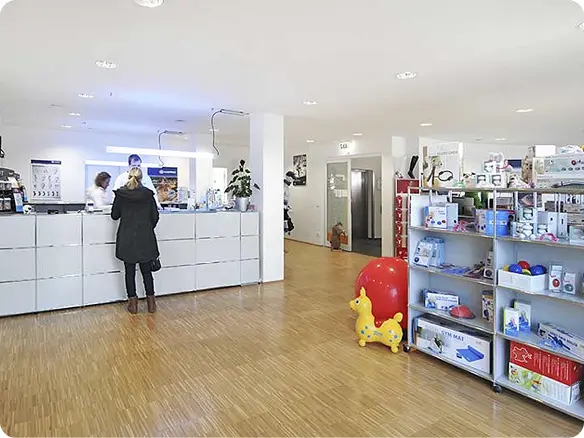
Secretariat of a medical practice with multiple screens – manual appointment coordination before the introduction of DoctorFinder
The solution

A middleware that thinks along

HighPots developed the DoctorFinder — a rule-based middleware that acts as an invisible layer between the patient, practice, and system.

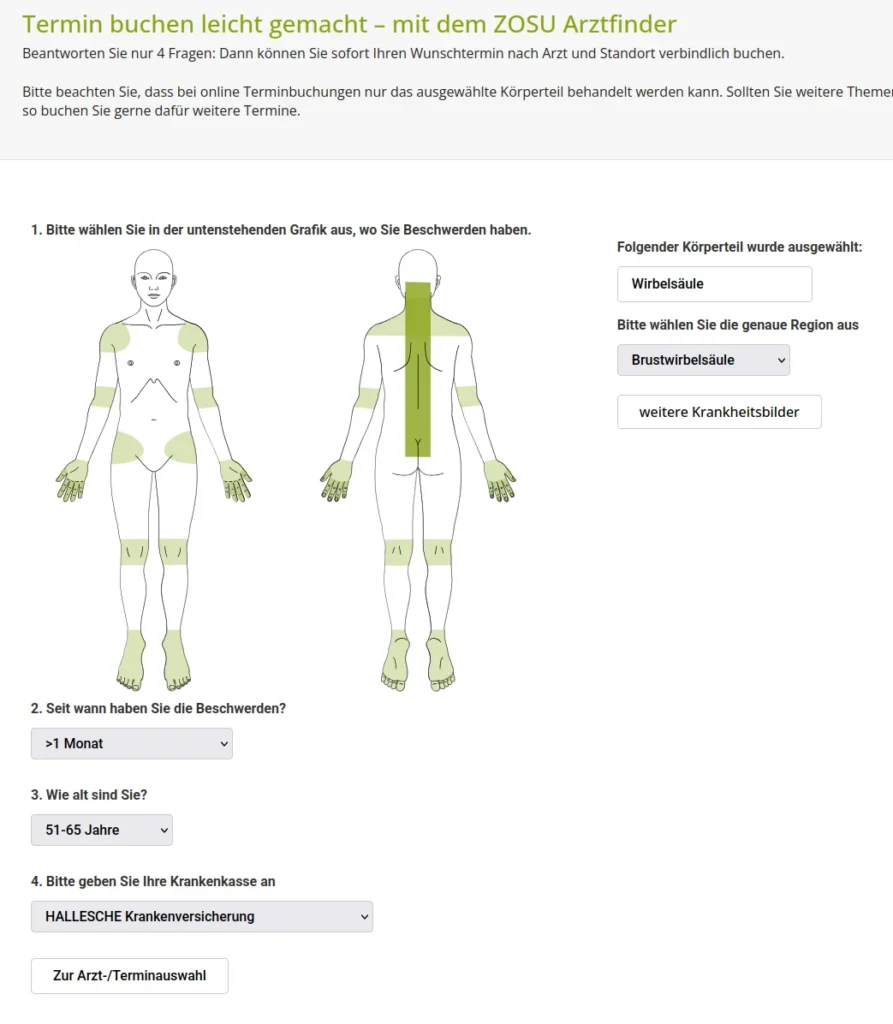
The process from the patient's perspective is quite simple:
1

Select illness profile

2

Specify health insurance

3

Choose desired date in calendar

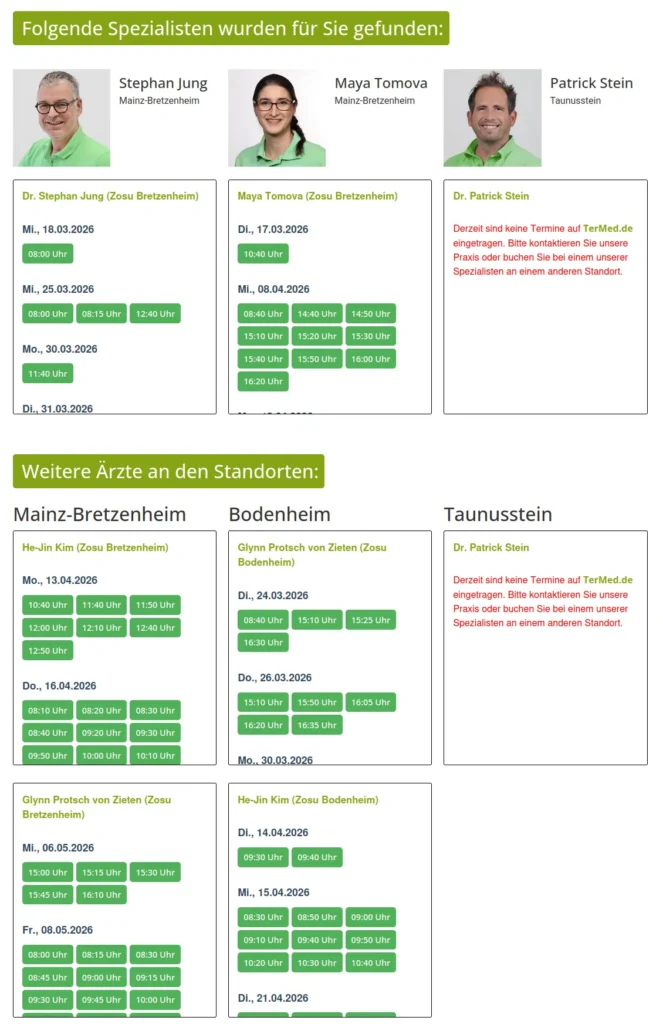
The system then displays exactly those doctors who match the complaint profile — and are available on that day.

Anyone who prefers a doctor from their last visit will see them automatically — provided they are not on vacation that day and still have available appointments.

What the patient does not see:

In the background, an assignment logic is running that processes medical and economic parameters simultaneously:

Type of insurance

Treatment history

Quarterly status

Location

Availability

After selecting the doctor, the middleware transfers all information directly into the patient management software and schedules the appointment with the corresponding doctor. No manual intermediate step. No secretariat as a bottleneck.

In the background, DoctorFinder connects the website with MedicalOffice — the practice software from ZOSU — as well as with Office 365-based routing chains for internal communication. The architecture was designed from the start to scale: in subsequent projects, the same logic was successfully integrated into environments with SAP IS-H on S/4HANA — the standard of large university hospitals.

Data protection was not an afterthought. Server operation exclusively in Germany, minimized data storage, complete documentation of all processing steps — oriented towards the strict requirements of German and Swiss data protection law.

The system then displays exactly those doctors who match the complaint profile — and are available on that day.

The system in action

DoctorFinder Screenshot – Patient selects body part and health insurance for automatic doctor assignment
Intuitive appointment booking with visual symptom selection
DoctorFinder Screenshot – Suitable specialists and available appointments after automatic doctor assignment
Real-time availability of doctors by location and specialty
The result

Less administration, more medicine

The numbers speak for themselves — and they came faster than expected.

50%

The Vitanum secretariat today saves around 50 percent of the time previously spent solely on appointment coordination. Fewer calls. Fewer inquiries. Less manual coordination between locations. The central secretariat — responsible for the entire MVZ — today manages with a smaller team than before the introduction of DoctorFinders.

20–25%

The second effect is economic in nature — and was surprising even for Vitanum in this clarity: Through the algorithmic control of patient assignment, revenues increased by 20 to 25 percent. Not through higher prices. Not through more patients. But because the right patient comes to the right doctor — and the billing logic in the background is consistently taken into account.

In short: The system works. Every day. Under load. Without anyone having to intervene.

Conclusion

What other companies can learn from it

The DoctorFinder is not medical software. It is an integration system — one that transforms complex sets of rules, heterogeneous system landscapes, and economic logic into an automated process. The industry happens to be medicine. The architecture behind it is universal.

Because the same basic structure is found in modern trade.

A WooCommerce shop that runs synchronously online and offline, reconciles inventory in real time, automatically assigns tax classes depending on the customer type, and transfers accounting data directly to DATEV — structurally, this is no different a problem than patient management in the MVZ. In both cases, it is about rule-based allocation under economic framework conditions. In both cases, multiple systems must communicate with each other that were not originally designed to work together. And in both cases, the quality of the integration architecture determines whether an operation scales — or sinks into manual chaos.

HighPots brings exactly this expertise:

Understood the processes. Connect systems. Automate the logic.

What began as an orthopedic large practice in Mainz-Bodenheim now runs in environments with SAP IS-H on S/4HANA — the standard for large university hospitals. And the same architectural expertise is behind the WooCommerce integration solutions that HighPots develops for retail.

Exactly this experience — transforming complex rule sets into reliable, automated processes — is what HighPots brings to every project, whether in healthcare or in WooCommerce trade.

Dr. Tolga Sancaktaroglu – Specialist in Orthopedics and Owner of ZOSU and Vitanum MVZ

In a medical care center with over one hundred doctors, the quality of our processes determines how quickly we can offer patients the appropriate treatment. HighPots has developed a system called DoctorFinder that relieves our staff, improves the quality of care, and ensures clearly structured processes — every day and under high demand. I fully recommend HighPots.

Tolga Sancaktaroglu

Specialist in Orthopedics, Trauma Surgery & Sports Medicine
Owner and practicing physician, Vitanum MVZ & ZOSU
Team doctor ASV Mainz 88 e.V. — 1st Bundesliga Wrestling
Team doctor ASC Theresianum Mainz e.V. — 2nd Bundesliga Women’s Basketball

Cookie Consent with Real Cookie Banner