
Employees transfer data manually between two systems.
The data are not the problem.
But the manual step between two systems.
AnyAgent automates transitions between systems – where APIs are missing or traditional automation fails due to exceptional cases.
We check whether AnyAgent fits your process.
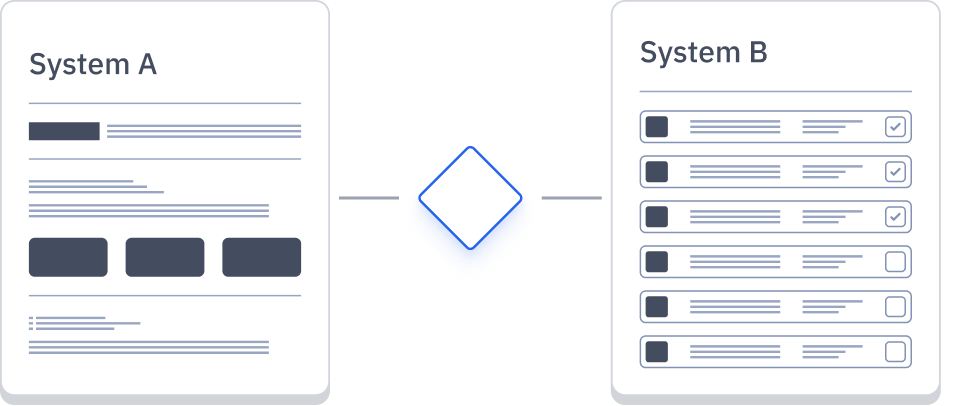
The problem: system breaks between systems
System breaks occur where two systems have to work together, but there is no seamless transition between them. The process runs – up to a point where a person must take over: check, assign, approve, decide.
This position is usually not a data question. It is a decision question. And it is the reason why
Processes also remain manual even in modern IT landscapes.
The pattern
Processes rarely break within a system. They break at the transition – where verification, assignment, or approval is required before the process continues in the next system.
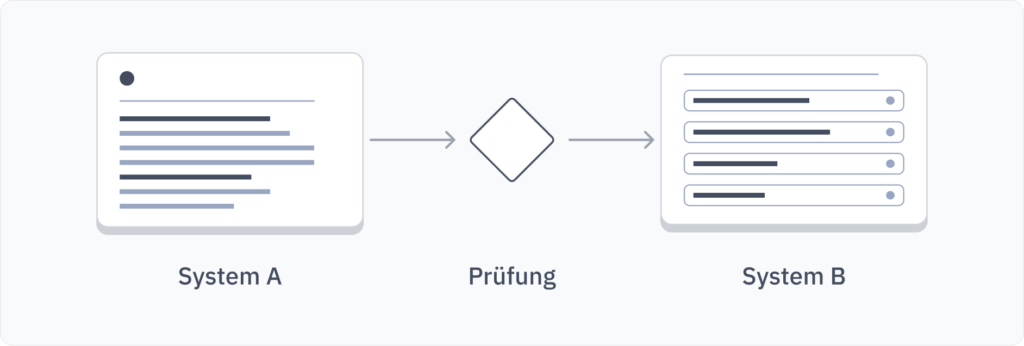
How to recognize the process breakdown
You recognize the process break by the following symptoms:
Why standard solutions don’t work here
The first guesses for such processes are usually: API or RPA. Both solve real problems – but not the manual verification and decision steps at the interface between systems.
Where APIs end
APIs can
APIs cannot
Why classical RPA breaks under complexity
RPA automates repeatable steps by recording and replaying user operations. This works as long as the inputs remain the same, the interfaces do not change, and the process does not contain a decision step. As soon as variants, exceptions, or checks come into play, the automated process breaks down – and the process falls back to manual handling.
AnyAgent: Hybrid agent for system disruptions
This is exactly where AnyAgent comes in.
AnyAgent is a hybrid agent for system breaks. It automates the points where processes are currently held manually between systems – even where no API exists or traditional automation is not sufficient.
AnyAgent uses APIs where systems provide them. AnyAgent serves interfaces where APIs are missing or insufficient. Decision logic is defined with you – requiring approval or automated, depending on risk.
Decision logic and approvals remain comprehensible and controllable.
Three typical use cases
Where this applies in practice is shown by three typical use cases:
Process invoices from supplier portals
Recurring invoices are located in portals of various providers – telecommunications, cloud services, utilities. They need to be downloaded, checked, and transferred to the accounting system. AnyAgent logs into the portal, downloads the invoice, compares it with the previous month, and prepares the booking in the accounting system.
Create offers from customer inquiries
Requests come in via tickets, emails, or forms and contain everything needed for an offer – distributed across multiple fields and systems. AnyAgent creates the organization and contact in the CRM, generates the offer based on the request, and submits it for review. It is only sent after approval.
Discount suggestions based on sales and market data
An item is often viewed in the shop but rarely purchased. Whether a discount promotion is economically viable depends on data from several systems – web tracking, competitor prices, marketing costs, and purchase prices from merchandise management. AnyAgent consolidates this information, suggests discount amounts and promotion periods with justification, and additionally checks before approval whether ongoing discounts collectively endanger the monthly fixed cost burden. The promotional price is only applied after approval.
The same pattern of transition, verification step, and approval is found in many other areas – travel expense management systems like SAP Concur, contract renewals, personnel processes, or logistics approvals. Everywhere that data must be checked in one system before a second
system processes it further.
The path from your process to productive deployment involves four steps:
1
Phase 1 – Analysis
We take up the process, identify the system break, and examine the technical feasibility. The result is a reliable assessment of whether the process can be sensibly automated – and at which points limitations or approvals remain necessary.
2
Phase 2 – Training
Data sources are connected, decision logic is defined together with you. You determine for each process step which actions AnyAgent executes directly and which are submitted for approval – depending on the risk of the respective decision.
3
Phase 3 – Introduction
AnyAgent initially runs on a limited scale. Results are reviewed, thresholds calibrated, and special cases added. Processes typically start with stricter approval rules; with increasing stability, individual steps can gradually be transferred to direct execution. The introduction phase ends as soon as the logic holds and the process runs stably.
4
Phase 4 – Operation
AnyAgent goes into regular operation. Logging and monitoring run along. Decision logic, thresholds, and approval levels remain adjustable during ongoing operations – without having to rebuild the process.
Schedule an initial consultation
We clarify in 30 minutes whether AnyAgent fits your process.
Architecture and Security
Positioning in the market
AnyAgent positions itself between classical integration methods and autonomous AI systems. The following overview places AnyAgent in comparison to established approaches:
| Feature | API Integration | Traditional RPA | AnyAgent | Agentic AI |
|---|---|---|---|---|
| Requirement | An interface/API must exist | Stable interfaces, repeatable processes | Combines APIs, interfaces, and documents — not limited to APIs | High-quality training data, defined tools |
| Handling Variants and Exceptions | Only structured, known formats | Breaks when interfaces change or deviations occur | Detects changed interfaces after provider updates and adapts interactions accordingly. Workflow optimization can be activated by the customer — every step is documented with screenshots and descriptions. Decision logic remains traceable. | Flexible, but non-deterministic — behavior may vary between runs |
| Reach and Combination | Only systems accessible via API | Only interfaces, one system at a time | APIs and interfaces can be combined bidirectionally, multiple systems in parallel, connectable with other agents | Mostly browser-based, rarely desktop (limited) |
| Traceability | High (deterministic) | High (script-based) | High — rules, logs, documented justifications. Self-optimizations are stored in a data room with screenshots and process descriptions. | Limited (LLM decisions difficult to reconstruct) |
| Level of Autonomy | Fully automated | Fully automated (within the script) | From fully autonomous to confirmation after every step — configurable by the customer | Usually designed for high autonomy |
| Customer Implementation | Customer IT or external integration team required | Bot development required (internal or outsourced) | HighPots handles integration and logic definition — no developer resources required on the customer side | Prompt design and training data often handled by the customer team |
AnyAgent starts where APIs are not enough, RPA breaks down due to complexity, and autonomous AI agents offer too little control. The combination of a rule-based core, free choice of operation method (API or interface), and customer-defined degree of autonomy makes AnyAgent suitable for exactly those processes in which data flow, decision-making, and approval currently have to be mediated manually between systems.
Deployment in your own data center or in your cloud
AnyAgent runs either in your own infrastructure, in a cloud environment controlled by you, or hosted by HighPots. Which option is suitable depends on your requirements for data sovereignty, compliance, and operation. Data flows between systems occur exclusively within the chosen environment.
Understandable logging
Every action – data retrieval, decision, approval request, execution – is logged. The logs are readable and can be analyzed without special tools. You can trace at any time on what basis AnyAgent made which decision.
Controllability during ongoing operations
Rules, thresholds, and approval levels remain adjustable at any time. Changes are documented with versioning. If necessary, individual process steps can be temporarily deactivated or switched to stricter approval rules without having to rebuild the entire process.
Connectivity to European regulation
AnyAgent is designed for traceability, documented decision logic, and human oversight – structural principles required by the EU AI Act for AI systems. AnyAgent runs on computers within your IT infrastructure and is therefore subject to your company’s existing group policies, user permissions, and security controls. Deployment can be fully conducted within European infrastructure and jurisdiction; outsourcing to non-European cloud infrastructures is not necessary. Which regulatory requirements apply to your specific use case depends on the risk classification of the process – this assessment is part of the analysis phase.
AnyAgent in the HighPots context
AnyAgent complements the existing product architecture of HighPots. For years, HighPots has been integrating systems such as SAP Concur, ERP, accounting, and commerce platforms in processes that span system, data, and organizational boundaries. AnyAgent follows the same architectural logic as PartnerConnect, the HighPots middleware for the corporate travel ecosystem: API integration, interface control, and rule-based decision logic interlock where processes are currently maintained manually between systems.
In the eCommerce environment, HighPots focuses on WooCommerce and integrates shop systems with POS, inventory management, and accounting. AnyAgent is not tied to a specific shop system and complements these integrations with the steps that must currently be decided manually between the involved systems.
Frequently Asked Questions
Where this applies in practice is shown by three typical use cases:
Is AnyAgent an AI agent?
AnyAgent can work autonomously – but it doesn’t have to. You decide for each process step which actions AnyAgent executes directly and which are submitted for approval. Unlike autonomous AI agents, the decision logic is rule-based and comprehensible; AI components are only used where structured rules are not sufficient – for example, in the interpretation of unstructured documents.
What is AnyAgent suitable for – and what is it not suitable for?
AnyAgent is suitable for processes that are currently performed manually between systems – with clearly definable decision rules and reproducible target states. AnyAgent is not suitable for creative tasks, for processes without definable logic, or for areas where human judgment cannot be represented by rules. Which processes are specifically suitable will be determined together in the analysis phase.
Does AnyAgent need training data or does it need to be trained first?
AnyAgent does not need to be trained for months with company data. The training consists of defining the decision logic together with you – which data is retrieved from which systems, which rules apply, and which steps are submitted for approval. This logic is rule-based and documented from day one.
Where is the data processed?
AnyAgent runs within your IT infrastructure – optionally in your own data center, in an environment controlled by you, or hosted by HighPots. In all variants, the deployment can be fully conducted within European infrastructure and jurisdiction. Outsourcing to non-European cloud infrastructures is not necessary.
What happens in case of errors or unexpected situations?
AnyAgent documents every action and every basis for decision-making. If inputs are outside the defined rules or a step fails, the process is not continued automatically but submitted for clarification. You determine in the training phase which cases are handled automatically and which require approval.
How does AnyAgent differ from traditional RPA?
Classical RPA records operation sequences and replays them – this works with stable interfaces and repeatable inputs, but breaks down with variants or exceptional cases. AnyAgent combines API access, interface control, and rule-based decision logic. Unstructured documents can also be processed. Exceptional cases are not ignored but handled in a defined manner – with release architecture where necessary.
The next step
Processes do not have to end at system boundaries.
We check whether AnyAgent fits your process.