

WooCommerce B2B is suitable as a capable shop system in many B2B applications.
What is important for the successful use of WooCommerce in B2B is explained in this detailed specialist article.
At this point, we would also like to show you 3 concrete case examples for the use of WooCommerce in B2B.
You will see: In many B2B scenarios, the use of WooCommerce provides measurable benefits. Maybe for you too? Feel free to contact us.
- Here you will find our development services for WooCommerce
- Fixed prices for your WooCommerce development
Three B2B Case Studies for WooCommerce in Practical Use
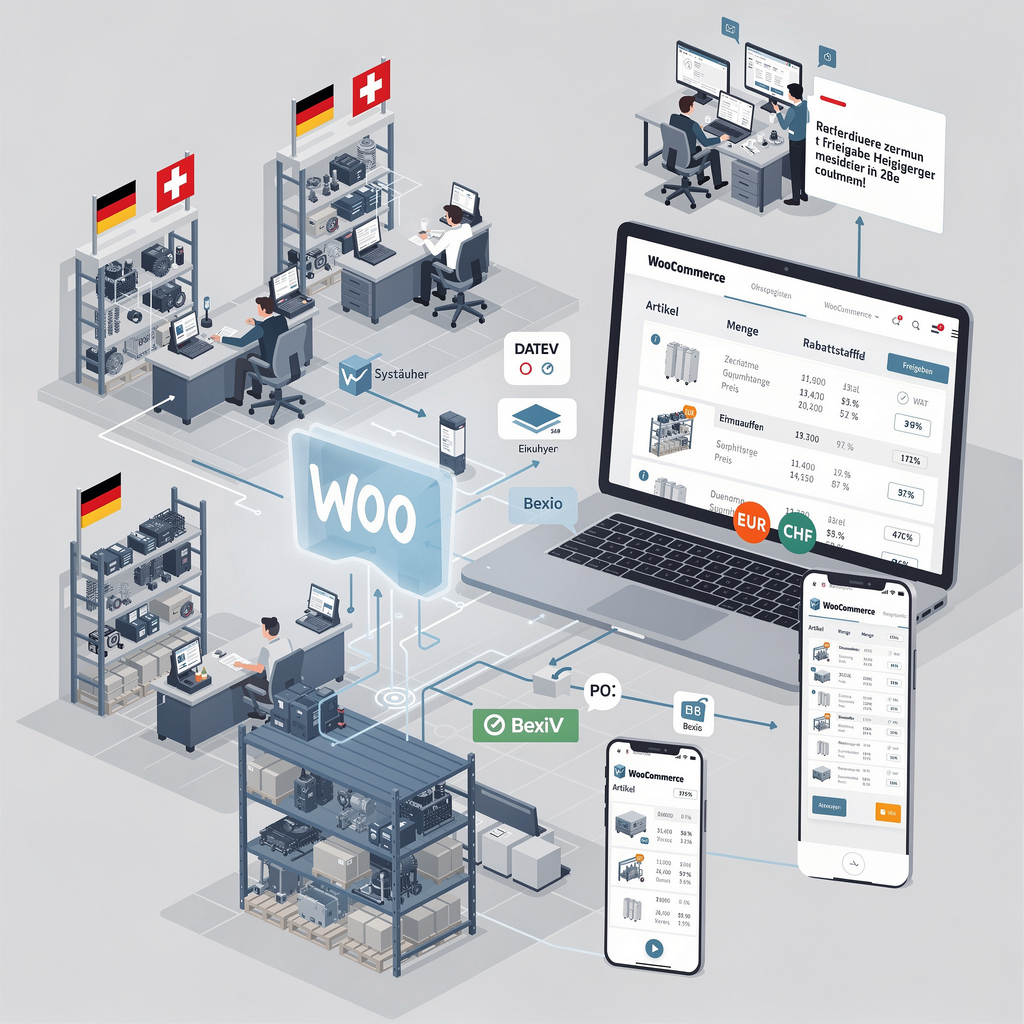
Case study 1: Technical wholesale with omnichannel strategy
A medium-sized wholesaler for technical equipment with three locations in Germany and Switzerland operates both retail stores and a traditional field service. The approximately 800 business customers increasingly expect the ability to order online around the clock – but at their individually agreed terms.
The B2B requirements
- Customer-specific price lists with up to five different discount levels depending on the purchase quantity
- Unified inventory across all channels (online shop, three branches, field service)
- Integration of the existing cash register systems in the branches
- Connection to DATEV for financial accounting in Germany and Bexio in Switzerland
- Different VAT rates and currencies (EUR/CHF)
- Role-based approvals: Not every employee at the customer is allowed to order independently
The WooCommerce solution approach
The WooCommerce shop can be designed as a central technical core that communicates with all relevant systems via API interfaces. HighPots, as a B2B WooCommerce system integrator, offers you professional eCommerce architectures. Customer-specific prices can be synchronized from the existing ERP system and stored in WooCommerce with customer-specific price tables. The WooCommerce-DATEV synchronization here does not run via an export from WooCommerce and an import into the ERP/inventory management system, but with real-time synchronization based on data objects. The POS cash register systems access the same inventory as the WooCommerce online shop.
A customized plugin can ensure the automatic transfer of orders to the respective financial accounting – depending on the customer location to DATEV or Bexio. The user role management uses the extended WordPress role system: Buyers can compile orders, approvers must approve them from a defined threshold.
Expected result
Such a solution enables WooCommerce omnichannel integration and significantly reduces inventory discrepancies. Business customers benefit from 24/7 availability and transparent presentation of their individual conditions. The manual effort for invoicing and accounting can be significantly reduced.

Case study 2: Training and seminar provider with complex booking logic
Initial situation
A training provider specializing in technical courses offers both open seminars and in-house training for companies. The previous booking system was a combination of Excel spreadsheets, email communication, and manual invoicing – prone to errors and time-consuming.
The B2B requirements
- Booking of seminars with limited number of participants
- Simultaneous booking of rooms, equipment and external trainers
- Different billing models: per participant, per day, flat rates for in-house training
- Multilevel registration: First the company books the seminar, then the individual participants register
- Integration into financial accounting (Abacus) for automatic invoicing
- Waiting list functionality for fully booked appointments
The WooCommerce solution approach
WooCommerce can be designed as a booking platform that maps multidimensional logic through specially developed extensions. Each seminar can be set up as a product with time-based variants (different dates). Capacity management is handled via the WooCommerce stock. Our WooCommerce course booking solution within our WooCommerce product StoreConnect offers these functionalities and much more.
A custom plugin can handle the multi-level booking logic: companies first book quotas, receive an access link, and can then register their employees as participants. Billing is done according to the contract model – either per actual participant or as a flat rate.
The connection to Abacus enables the automatic generation of participation certificates and invoices. External trainers have access to their scheduling through a separate portal.
Expected result
The administrative effort for seminar management can be significantly reduced. The error rate in participant registrations is minimized. Companies can manage their participant quotas themselves. The provider is able to organize more seminars with the same personnel effort.
Interested in this scenario? Contact us.
Case study 3: Technical services with project-based billing
Initial situation
An engineering office offers technical consulting, expert reports, and maintenance services. Billing is partly hourly-based, partly through flat-rate projects, and partly through maintenance contracts with monthly flat rates. The previous solution – a combination of Word templates and manual time tracking – reached its limits.
The B2B requirements
- Different billing units: hours, projects, monthly flat rates
- Customer-specific hourly rates depending on contract type (framework agreement vs. individual project)
- Combination of products (spare parts, consumables) and services
- Project-related documentation: Which services were provided when for which project?
- Automatic invoicing for maintenance contracts (monthly/quarterly)
- Connection to DATEV for accounting and project cost accounting
The WooCommerce solution approach
WooCommerce can function as a billing and project management platform. An individual user account with stored conditions can be created for each customer. Projects can be structured as their own product categories, under which both hourly services and materials can be booked.
A specially developed plugin enables time-based billing: engineers record their working hours, which are automatically assigned to the corresponding projects and clients. For framework contracts, stored special hourly rates apply, while for individual projects, the standard rates apply.
Maintenance contracts can be mapped via WooCommerce Subscriptions and automatically trigger monthly or quarterly invoices. The DATEV integration ensures continuous project cost accounting from the first time entry to bookkeeping.
Expected result
Invoicing can be largely automated. Customers have access to their project costs and current status at any time through a portal. The transparency leads to a reduction in inquiries and the need for clarification. The time from service delivery to invoicing can be significantly shortened.
Interested in a free consultation appointment? Schedule an appointment.
Common success factors of the case studies for WooCommerce B2B:
All three case studies show similar success patterns:
Clear architecture from the start: In no case would WooCommerce be considered as an isolated solution, but rather as an integral part of an overall architecture.
Targeted development instead of a collection of plugins: Instead of relying on a multitude of standard plugins, bespoke solutions tailored exactly to the business logic would be developed.
Clean system integration: The connection to financial accounting and other inventory systems would be part of the concept from the start, not an additional feature added later.
Realistic expectations: In all cases, it would be clear that WooCommerce provides a technical framework, but the actual business logic must be deliberately modeled.
These examples illustrate: WooCommerce can work in B2B – if the framework conditions are right and the platform is understood for what it is: a flexible, expandable core for customized e-commerce solutions.
We are your partner for successful WooCommerce projects. Contact us – or find out about our price packages for WooCommerce development.
WooCommerce is only as good as the foundation it stands on – a secure and stable as well as high-performance WordPress system.
